


Osprey: AI-Powered Geospatial Intelligence for Smarter Decision-Making
Osprey harnesses the power of AI and machine learning to analyse geospatial data with precision, speed, and scalability. Whether you’re monitoring environmental changes, optimising land use, or enhancing disaster response, Osprey delivers the intelligence you need to act with confidence.
With Osprey, you can access advanced AI tools directly through your web browser, streamlining workflows and enhancing productivity with no heavy installations or complex setups. Whether you need AI-driven segmentation, remote sensing classification, or spatial indices processing, Osprey delivers fast, reliable results every time. Here’s what makes Osprey a game-changer:
Comprehensive image Processing
Effortlessly prepare your images for analysis, with support for a variety of formats from GeoTiff JP2000 and compressed files like .tar.gz. Osprey's platform is designed to handle everything from optical to SAR imagery, empowering you to get the most from your data.
Seamless Al Model Integration
Take advantage of powerful Al models to perform complex tasks such as segmentation. Osprey's intuitive interface makes integrating Al into your workflows easy and effective, providing instant access to insights that drive decision-making.
Advanced Processing Options
Transform your geospatial data with options for Al-based segmentation, classification to vector formats, 8-bit pixel value stretching, spatial filtering, and indices processing. Designed for today's geospatial professionals, Osprey's advanced tools let you get the precise results you need, every time.
Batch Processing For Efficiency
Process large volumes of imagery with ease using Osprey's batch processing capabilities. Manage, queue, and monitor jobs in real time to ensure efficient, uninterrupted analysis - even for the largest datasets.
Flexible Billing
With Osprey, you only pay for what you use. The transparent, pay-per-pixel billing model ensures that you're only charged for the data you process, making it a cost-effective solution for organisations of all sizes.
Why Osprey?
In today’s fast-paced world, decision-makers need access to accurate insights at their fingertips. Osprey is built for organisations that demand high-quality geospatial data analysis without the hassle. No need for installations or specialised hardware – all you need is a web browser and an internet connection.
Whether you’re in environmental monitoring, urban planning, agriculture, or defence, Osprey’s tools are here to help you make data-driven decisions faster and smarter.
Explore the documentation to get started and see how Osprey can transform the way you work with geospatial data.
AI in remote sensing is also not a new idea. As far back as 1977, the US Naval Research Laboratory was researching AI applications for remote sensing and throughout the 90s and early 2000s, academic papers were published on the use of a range of different AI techniques in the remote sensing and earth observation fields. The development of deep convolutional neural networks using GPUs for computer vision problems since the early 2000s, and the increasing availability of high[1]performance computing hardware, rapidly increased the performance and accuracy of the AI models applied to remote sensing tasks. The volume and resolution of satellite imagery has also been increasing substantially, making it apparent that new analysis tools were needed to manage the larger and more complicated datasets used by geospatial professionals.
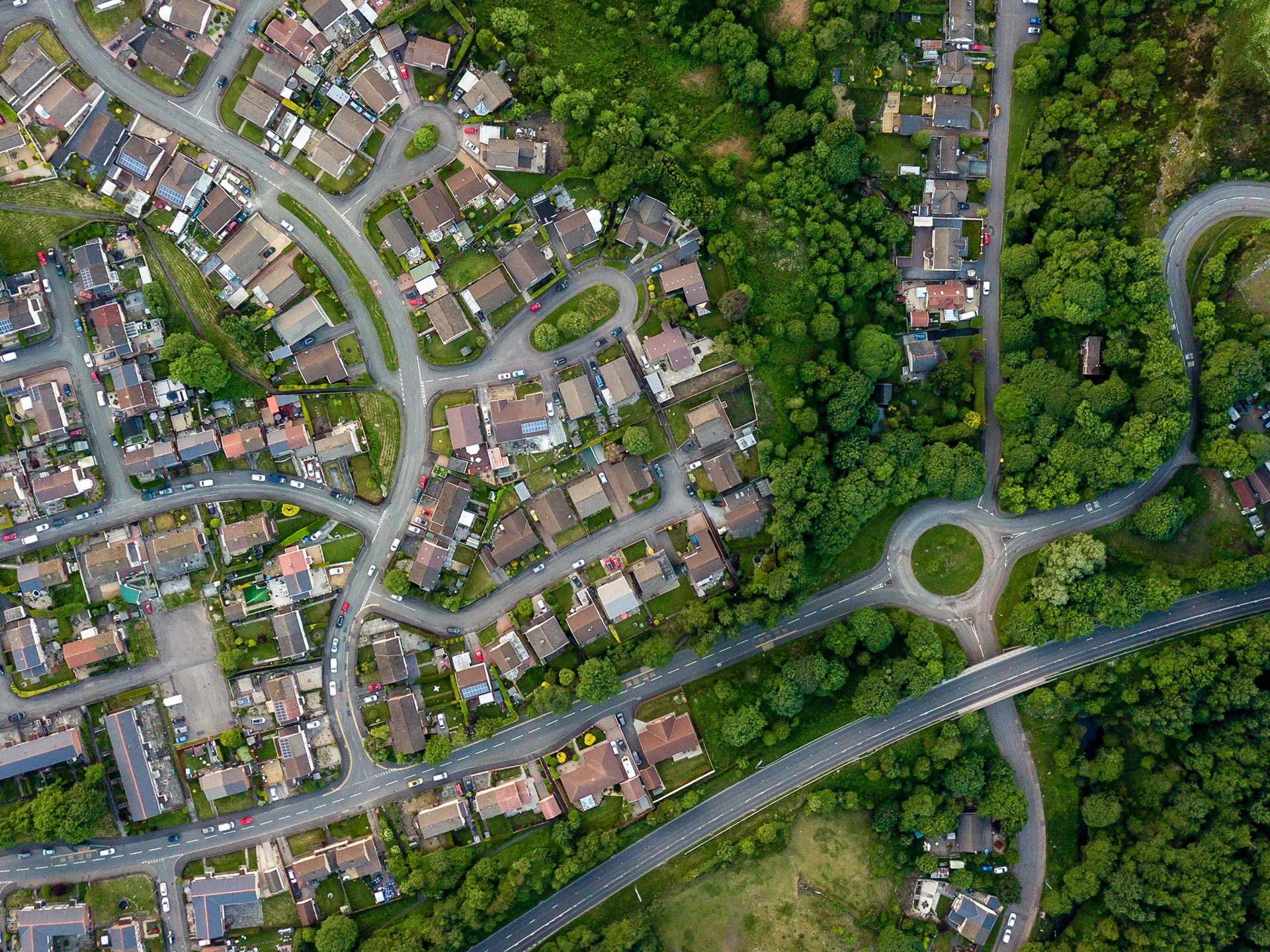
Convolutional Neural Networks (CNN) are a form of Deep Learning algorithm heavily used in computer vision. They are also extremely well-suited to remote sensing, in particular object detection and segmentation tasks. In object detection, the aim is to identify and classify objects and their location within an image, for example finding all the houses in a satellite image. Segmentation is a pixel-based classification of an image, such as identifying every road pixel in an image, making it ideal for feature extraction tasks. The reason that CNNs are so well-suited to these tasks is that they can capture the Spatial, Spectral, and even Temporal dependencies within images and learn patterns. The spatial aspect of CNNs is particularly useful for remote sensing. Where a traditional pixel classification algorithm might use the spectral signature of a single pixel to determine its class, a CNN can use a square of 512x512 pixels (or more) and their related spectral information to determine the class of a single pixel. This means that a CNN can, for example, be trained to recognise linear features such as a road, based not only on a pixel’s spectral signature, but also from its shape and surrounding environment in much the same way a human brain does. In fact, CNNs have some advantages over a human brain. Due to the way computer screens display satellite imagery, a human analyst can only see three colour channels at a time, and then only in roughly 8 bits of data per channel. Most electro-optical satellites capture imagery in four or more channels (red, green, blue, near infrared) and at 12-16 bits per channel. A CNN is able to process all of this information at once, where as a human analyst would need to switch between channels and adjust the image “stretch” to be able to properly view the data.
Clearly, CNNs have a lot of advantages over the more traditional remote sensing methodologies, but they also have some limitations. A CNN model can be trained to be very good when applied to a specific problem space, for example extracting road networks from very-high resolution imagery, but the model may not be very flexible. Training a model for a new problem space requires specialised skills, hardware, and time. The AI development process is discussed further in the next section.