Rear view of a commercial aircraft descending toward a runway at sunset, with runway lights glowing and mountains in the distance.

Case Study: Beyond ADS-B: How Atlas and Aireon VECTOR Flight Revealed Position Anomalies During a Flight Across Iranian Airspace

Overview

Modern aircraft tracking relies heavily on ADS-B position reports, delivering unprecedented visibility across the globe through satellite-based surveillance networks. However, in regions where GNSS performance may be degraded or where navigation environments become more challenging, analysts often need additional tools to assess the reliability of reported aircraft positions.

This case study demonstrates how Atlas, integrated with Aireon VECTOR Flight, helped identify and analyse positional anomalies during the flight of AUV2704 (ICAO 507CC9) as it transited Iranian airspace.

Overview The Flight

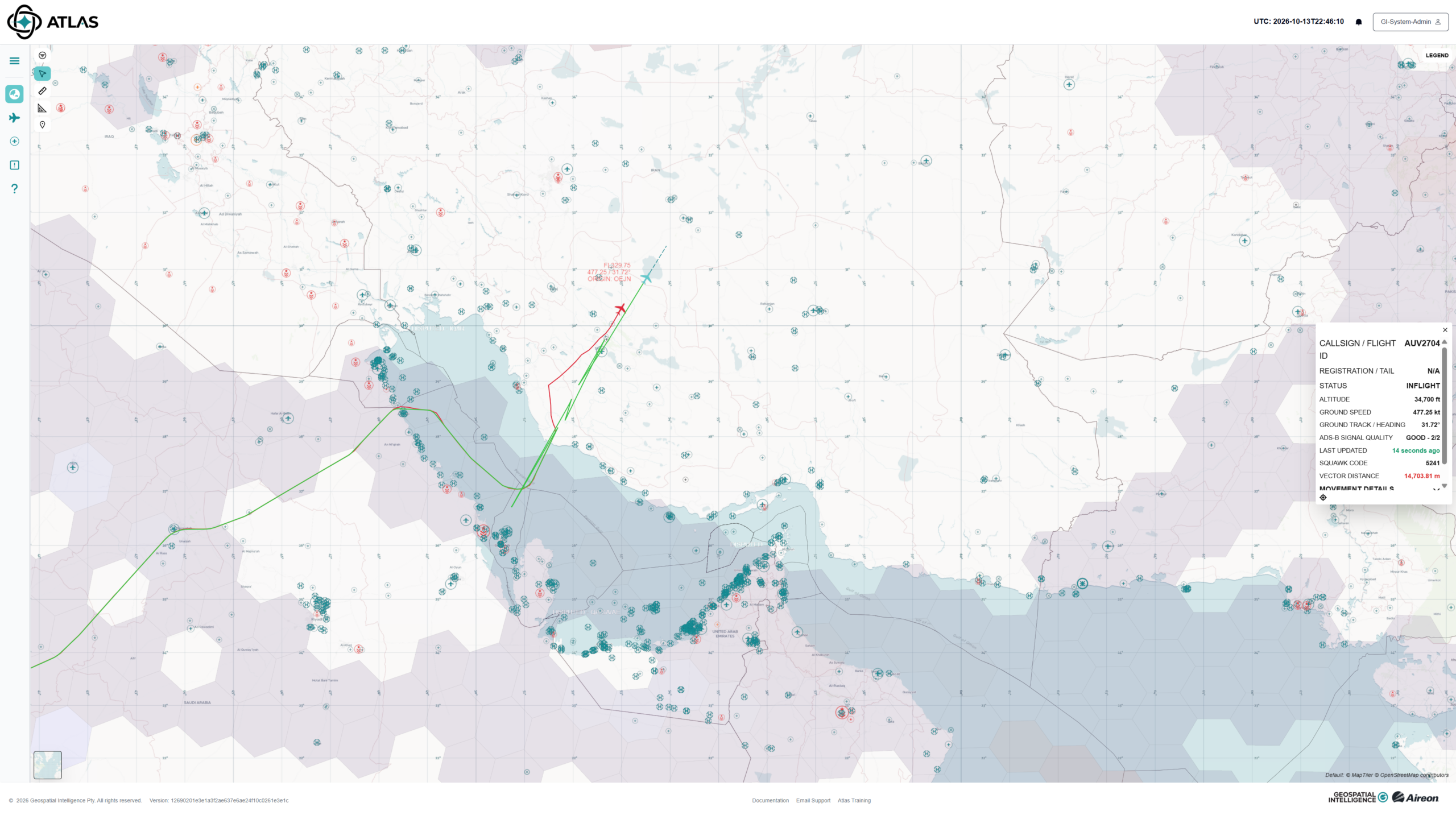
Using Atlas' global surveillance capabilities, analysts were able to maintain continuous visibility of the aircraft throughout its journey.

The Challenge

During the aircraft's transit through Iranian airspace, Atlas identified irregularities in the ADS-B-derived flight track.

While the aircraft continued to report position updates, the resulting track displayed characteristics that reduced confidence in the reported trajectory:

  • Inconsistent track geometry
  • Apparent jumps in reported position
  • Reduced continuity compared to preceding segments of the flight
  • Increasing separation between the reported track and independently derived movement analysis

For operators and analysts, these conditions create uncertainty when attempting to assess an aircraft's actual movement and location.


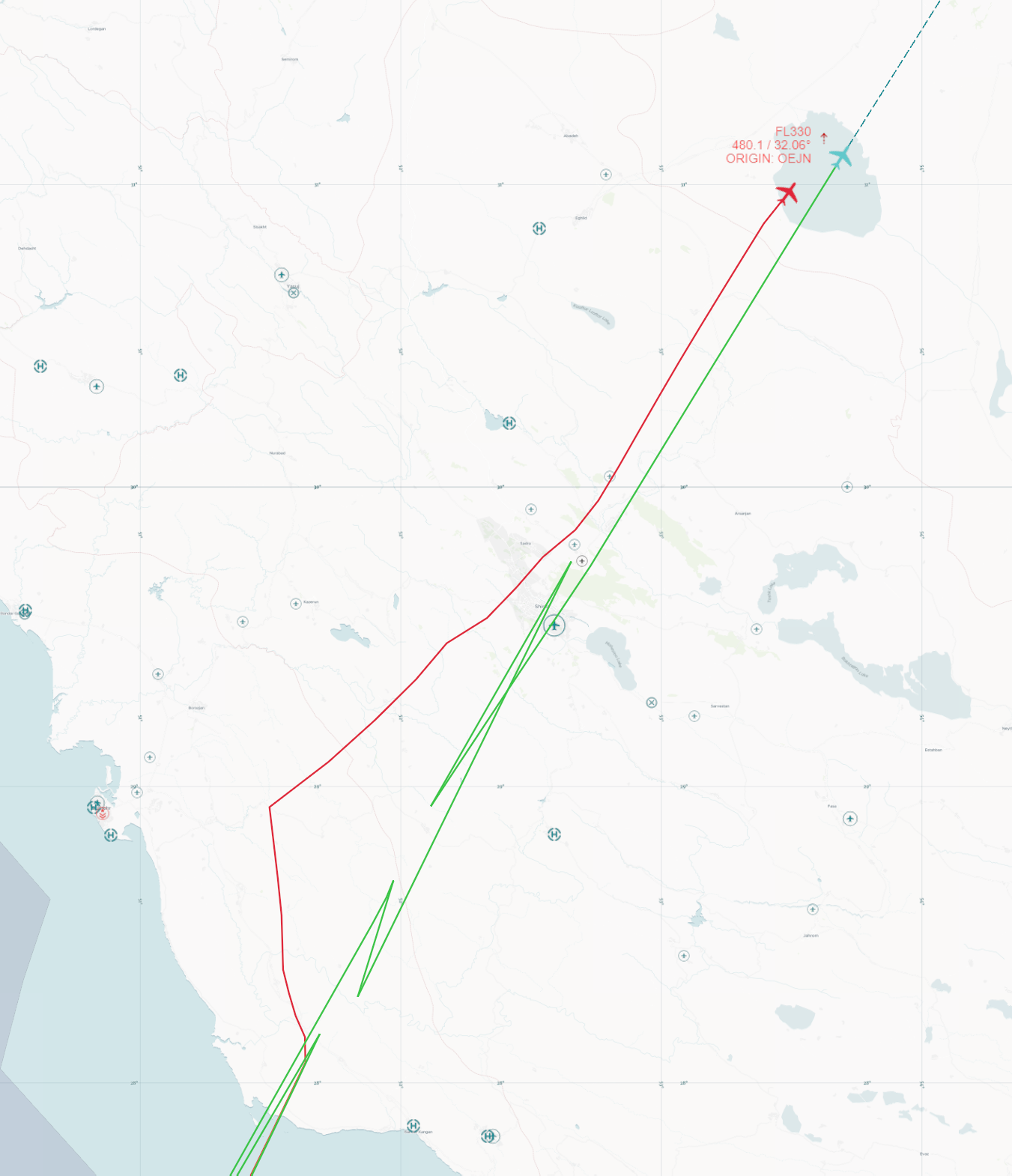
T ADS-B Flight Path

The image below shows the aircraft's reported ADS-B track (green).

Across the section of interest, the track exhibits noticeable deviations and inconsistencies compared to the surrounding flight path.

Meanwhile, the independently generated Aireon VECTOR Flight track (red) follows a smoother and more coherent trajectory.

The Atlas Advantage

Atlas integrates Aireon VECTOR Flight analytics directly into the operating environment, allowing users to compare reported aircraft positions against independently derived trajectory models.

VECTOR Flight does not simply display reported positions. Instead, it uses movement analysis and trajectory modelling to generate an additional analytical perspective on aircraft location and movement behaviour.

By visualising both datasets simultaneously, Atlas enables analysts to rapidly identify areas where reported flight data may require further scrutiny.

In this example, the difference between the ADS-B-derived route and the VECTOR Flight path became increasingly pronounced as the aircraft progressed through the area of interest.

Quantifying the Divergence

Visual inspection can identify unusual behaviour, but quantitative analysis is essential for operational decision making.

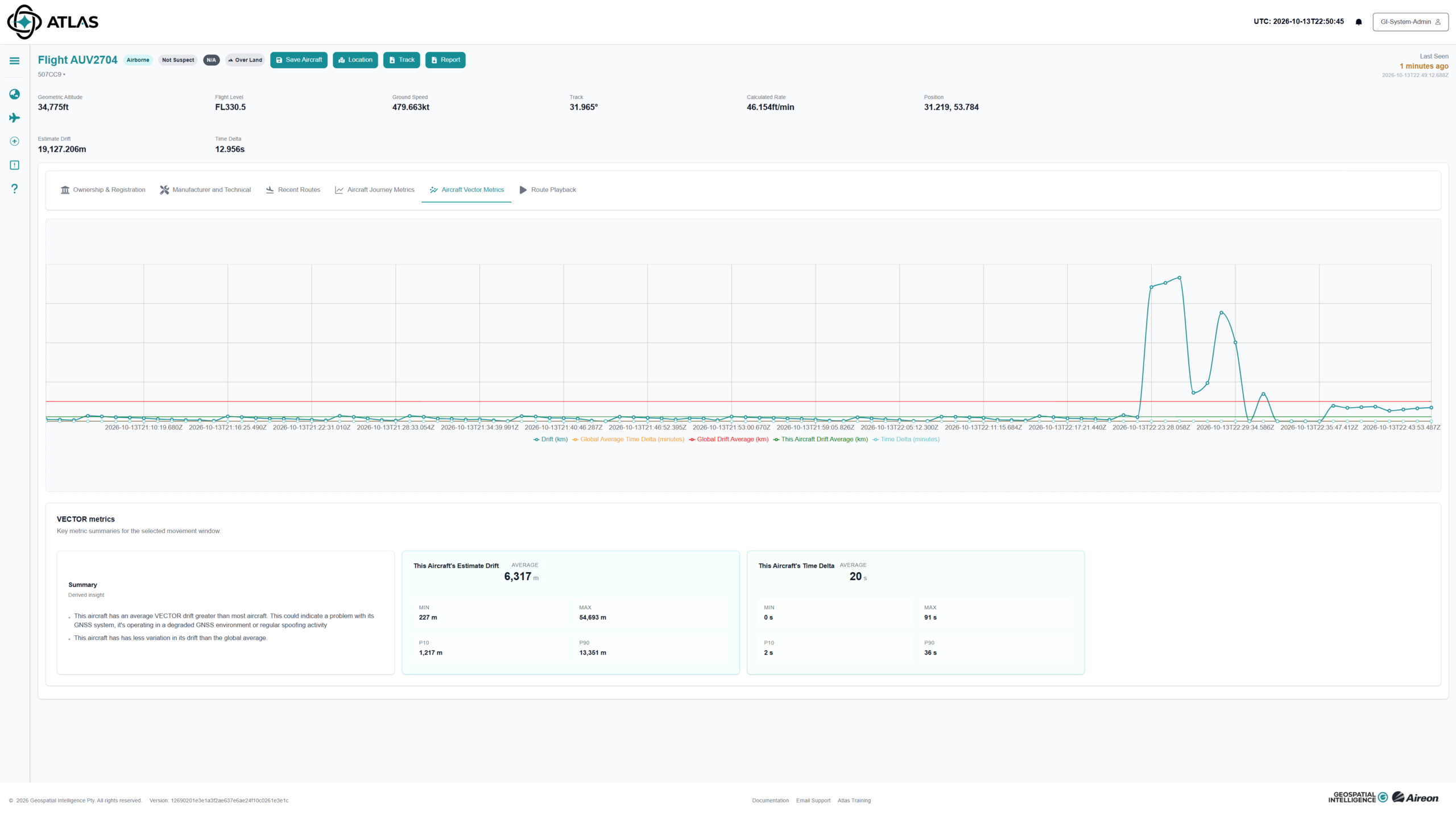
Atlas surfaces VECTOR Flight metrics that allow analysts to measure and monitor divergence between reported and derived aircraft positions.

The VECTOR Flight analytics for AUV2704 revealed:

  • A sustained increase in positional drift
  • Growing divergence over time rather than isolated anomalies
  • Elevated VECTOR distance measurements compared to expected norms
  • A consistent trend indicating increasing separation between the reported and derived trajectories

These metrics transform what could otherwise be dismissed as visual anomalies into measurable indicators that warrant investigation.

Operational Impact

For intelligence analysts, aviation authorities, and operational monitoring teams, the ability to identify and quantify positional anomalies is becoming increasingly important.

Atlas provides:

  • Enhanced Situational Awareness
    • Users can see not only where an aircraft reports itself to be, but also how that position compares with independently derived movement analysis.
  • Faster Anomaly Detection
    • Visual overlays and analytics immediately highlight unusual aircraft behaviour that might otherwise remain hidden within large volumes of surveillance data.
  • Greater Analytical Confidence
    • By combining global ADS-B surveillance with Aireon VECTOR Flight analytics, users gain additional evidence when assessing aircraft movements
  • Actionable Intelligence
    • Rather than relying exclusively on position reports, analysts can use measurable drift and divergence metrics to support investigations and operational decisions.

Conclusion

Global surveillance provides visibility.

Analytics provide confidence.

In the case of AUV2704, Atlas and Aireon VECTOR Flight enabled analysts to identify a growing discrepancy between the reported ADS-B track and an independently derived flight trajectory, providing additional context that would not have been apparent from ADS-B data alone.

As aircraft continue to operate in increasingly complex and contested environments, the ability to detect, quantify, and investigate positional anomalies is becoming a critical component of modern aviation intelligence.

Atlas combines global aircraft surveillance with advanced analytics, helping organisations move beyond tracking aircraft to understanding the quality and integrity of the data behind every flight.

Scroll to Top