
About
An orchard enterprise in Australia sought a more efficient way to assess tree health across its plantation. Traditional monitoring methods were time‑consuming and made it difficult to identify early signs of tree damage, disease, or stress. To address this challenge, Geospatial Intelligence was engaged to carry out a remote sensing–based assessment that could rapidly detect unhealthy or damaged trees using advanced classification techniques and satellite imagery.
The Challenge
The orchard and surrounding agricultural environment faced several operational and environmental challenges that threatened productivity, sustainability, and long‑term viability.
The primary risks identified included:
-
TREE HEALTH VARIABILITY
Tree damage and decline can occur unevenly across orchards, making manual detection slow and inefficient. Identifying unhealthy trees early is essential for maintaining yield and orchard longevity.
-
IMAGERY & SENSOR LIMITATIONS
Terrain, soil type, and seasonal conditions can influence the accuracy of remote sensing methods, requiring careful evaluation of the most effective sensor types and imagery collection timing.
-
NEED FOR RELIABLE CLASSIFICATION METHODS
Choosing the right analytical approach—such as vegetation indices or spectral classification—is crucial for accurately distinguishing healthy versus damaged trees.
Outcome
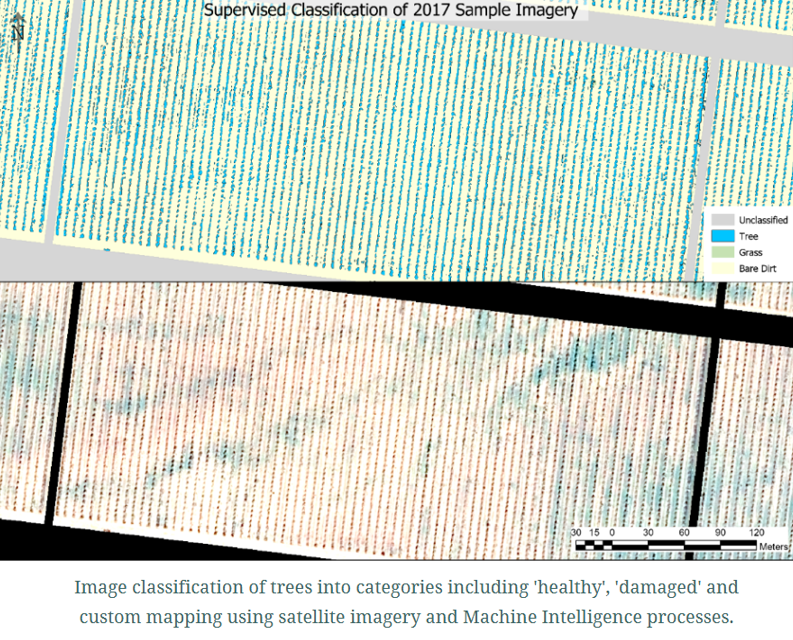
We delivered a detailed comparative tree‑health report mapping the location of unhealthy, dead or damaged trees alongside total tree counts for the assessment area. Using a normalised difference vegetation index (NDVI) at the paddock level, we produced highly interpretable outputs, including:
- a full tree‑health classification map,
- a methodology and model‑accuracy report, and
- a GeoTIFF image package for client use.
This project enabled the orchard to make faster, data‑driven decisions, lowering operational costs and improving long‑term orchard health.